|
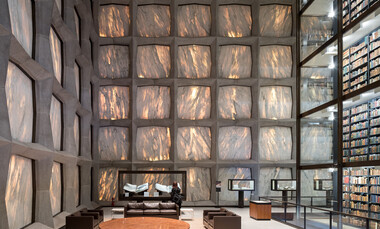
In 1742, when the Yale library had grown to include some 2,600 titles, President Thomas Clap, felt the need to describe them in a systematic way. The result was A Catalogue of the Library of Yale-College in New-Haven, printed the next year in New London by Thomas Green. "I have here with considerable Labour and Pains," Clap wrote, "prepared a Catalogue of the Books in the Library under proper Heads that so you may Readily know and find any Book, upon any particular Subject." To the making of catalogs there is no end, and even in the day of automation and networks, when detailed information about the library's holdings is just keystrokes away, it is useful to take a broader view. We hope that this new edition of the Beinecke Library Guide, like President Clap's catalog, will offer such a perspective on the collections and on the library as a whole, identifying particular authors and subjects that may be studied here. When the collections that make up the Beinecke Library were moved to the new building in 1963, the change was a dramatic enhancement of a long process of rare book and manuscript collecting at Yale. It was also a new beginning. Trend-setting acquisitions have been made during the Beinecke decades--one thinks of papyri and illuminated manuscripts, the Ezra Pound papers, the Spinelli archive, the papers of the Texas Verein. The new library provided an opportunity to create depth, to reach a critical mass where the forces of synergy would be released. The collections, as they grew, began to interact. While our holdings are still described in this Guide "under separate heads," it will be apparent that the general collection, the Osborn Collection, and the German Collection, although each has its own history and emphasis, supplement each other in documentating European history and literature. The American Literature and Western Americana collections have overlapping interests in Native American cultures, in the literature of the Southwest, and in American material culture. Photography, art history, modernism, printing history, and exile literature, are only a few of the other cross-currents that make the Beinecke more than the sum of its parts. The books that Thomas Clap listed in 1742 have been reassembled, as far as possible, and may be seen on the south side of the Beinecke Library book tower. While we still acquire old and rare books in almost all fields, many of Clap's "proper Heads"--natural history, divinity, law, and the rest--have long since grown into major collections, even separate libraries. The Beinecke, for its part, has concentrated on history, languages, and literature, with a particular emphasis (would Thomas Clap have approved?) on his last category "Plays and Books of Diversion"--Addison, Pope, Shakespeare, Spenser, Cervantes--along with a growing number of their literary descendants: Wordsworth, Byron, Shaw, Wilder, O'Neill, Milosz to name only a few. The pages that follow attempt to outline these rich and diverse collections as they stand today. It has not been an easy task--like President Clap's, our labor and pain have been considerable. Manuscripts, letters, and archival collections are filling the shelves of the Beinecke Library at a rate that would probably surprise those who planned the building. To our avid accumulation of books, we have added new genres, such as photographs, maps, art works, and scores. In short, the library's holdings have achieved a depth that makes brief descriptions sound superficial, and a breadth that resists coherent summary. Thomas Clap addressed the introduction of his Catalogue to the students of Yale College, hoping to influence the educational process with recommended readings. Our mandate is still to support Yale's educational programs, if less prescriptively. But unique collections bring broader responsibilities, and to our educational role at Yale is added another as an international center for advanced research in a variety of literary and historical fields. We hope that this Guide, published to commemorate the Beinecke's thirtieth anniversary, will serve all of our readers--Yale students, faculty, and alumni, Beinecke fellows, scholars and bibliophiles around the world. While university presidents rarely prepare library catalogs these days, the good ones retain Thomas Clap's respect for the formative influence of library collections. At the twentieth anniversary of the Beinecke Library, almost a quarter of a millennium after Clap's Catalogue, A. Bartlett Giamatti spoke of the Beinecke's "centrality to Yale University's mission," its role in preserving our civilization and fostering the minds that interpret, augment, and transmit that heritage. With this Guide we gratefully honor the benefactors, scholars, students, and librarians, across three centuries, who have made the Beinecke Library strong and who, even now, carry it faithfully and productively into another decade, another century. Ralph Franklin, DirectorComments:Ellen R.
Cordes, ellen.cordes@yale.edu |