|
120
High Street
Housing approximately
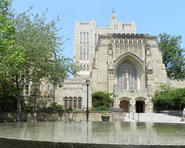
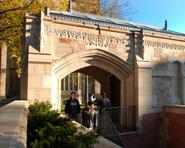
4 million volumes, Sterling Memorial Library is the largest library on the Yale
campus and serves as the center of the library system. The building, completed
in 1930, was designed by James Gamble Rogers (Yale 1889) as a memorial to John
William Sterling (Yale 1864), who donated much of his fortune to Yale. Sterling
Memorial Library, which Rogers remarked was "as near to modern Gothic as we dared
to make it," is made up of fifteen stack levels and eight floors of reading
rooms, offices, and work areas. The collections, devoted primarily to the
humanities and social sciences, are housed mainly in the bookstacks, which are
open to those with a valid Yale NetId or a special visitor's
access pass. Sterling's main public services and reading rooms are on the first
and basement floors. Also on the basement level are a lounge and the entrance
to the tunnel that connects Sterling to the Bass Library, where the intensive-use collection is housed. A major renovation
of the bookstacks and several reading rooms was completed in 1998, as was the
Irving S. Gilmore Music
Library, whose entrance is on Sterling's first floor (NOTE:
The Music Library hours of operation differ from those of the Sterling Memorial
Library).
For a glimpse of
the Sterling Memorial Library at the time of its completion, peruse the digitized
April 1931 issue of The Yale University
Library Gazette. In addition you can search the text for details of inscriptions,
images, and other symbols in and around the building.
Areas and Resources
of Sterling Memorial Library
Travel
Directions to Sterling Memorial Library
Sterling Nave
Circulation
Desk
Here
one may charge out library materials, place
holds, recall materials
charged to someone else, request that books be paged
from the stacks, and request assistance in locating materials in the stacks.
Books in the Sterling stacks may be paged from this desk between 8:30 a.m. and
5:00 p.m. weekdays. Books from most other Yale libraries may be requested here
as well through the Eli
Express service. All of these standard circulation services may also be completed
using the Place Requests feature from any search results page of the online
catalog, Orbis.
Circulation
and Access Services
SML Circulation Policies
Stack Directory
Reference Desk
The librarians
and reference assistants at the Reference Desk provide assistance with the identification
of sources on a particular subject, the location of materials, or questions
concerning the library's operations and procedures. Librarians can also
provide information about a number of special services that the library offers
such as interlibrary loan, book acquisitions, and the many electronic databases
to which Yale provides access.
During the academic
year, the Reference Desk is staffed during the following hours:
Monday through
Friday: 8:30 a.m.-5:00 p.m.
Monday through Wednesday evening hours:
5:00 p.m - 8:00p.m.
Saturday and Sunday: 1:00 p.m.-5:00 p.m.
During the summer,
the hours are:
Monday through
Friday: 8:30 a.m.-5:00 p.m.
Research
Services and Collections
Hours for All Yale Libraries
Orbis and the Card
Catalog
Orbis, together with
Morris, the catalog of the Law Library, is
Yale's online catalog, which represents the Library's catalog records that have
been converted to electronic form; currently Orbis contains almost four million
records. These records represent all materials cataloged since 1977, an increasing
number of records for materials cataloged before 1977 as the Library undertakes
that "retrospective conversion"
of its card records, and brief records for many older materials which have circulated
since 1981. The Library's major project to convert the information
remaining in the card catalog to electronic records
was complete by 2002.
Orbis
and a wide variety of other networked information resources can be accessed
through any networked computer on campus, including those in the College computer
clusters and personal computers in student rooms, and also off campus (using
Yale's Internet service or the proxy
server). Within Sterling, computer workstations offering access to Orbis
as well as to the Internet and the Web are located in the Nave, and Bass Campus Library as well.
The Library's Web site offers fast
and easy access to Orbis, to many databases to which the Library subscribes,
to other libraries' catalogs, and to general information about the libraries
at Yale.
CD-ROM Reference
Center
The CD-ROM
Reference Center across from the Reference Desk is a cluster of workstations
which provide access to a variety of reference resources and bibliographies in electronic form. These workstations are not networked,
so it is necessary to come into the Library to use the sources located on them.

General Reading Rooms
The Starr Main
Reference Room (First Floor) houses the main reference collection in Sterling.
This is a non-circulating collection that has been carefully developed to contain
materials that will provide answers to factual questions -- such as general and
specialized encyclopedias, language dictionaries, biographical dictionaries,
handbooks, and directories -- as well as bibliographies, indexes, and abstracts
in the social sciences and humanities. The arrangement of the collection is primarily
by call number, but encyclopedias, standard indexes and abstracts, including newspaper indexes are shelved in index cases just inside the entrance
to the Room. The National Union Catalog is on shelves at the back of the reference room annex.
Newspaper
Reading Room (First Floor) houses Sterling's current newspaper collection,
numbering over 200 titles. Recent issues from all over the world are out on open
shelves. United States newspapers are shelved down the left side of the room,
alphabetically by title. Foreign titles are shelved down the right side of the
room by broad geographic area. A list of the newspapers, arranged by geographic
area, is kept on the Newspaper
Reading Room Web page.
Microform
Reading Room (Basement) contains Sterling's extensive microfilm and microfiche
collections, as well as several very useful CD-ROMs indexing newspapers and manuscript
materials. The Microform Reading Room Web
page includes a list of major microform collections. The room is open and
staffed whenever Sterling is open.
Franke Periodical
Reading Room (First Floor) houses the current issues of about 5,800 of the
over 63,000 journals and other serials received by the library system. The current
issues are arranged in this room in broad subject areas, such as History or Literature,
in order to facilitate browsing the current literature of a field. Each of these
subject areas shelves in one of the 20 numbered sections of the room. Within
each section, the arrangement is alphabetical by title. Although Sterling has
no separate section for all bound periodicals, as do many other libraries, the
bound issues of approximately 90 of the most heavily-used journals, including
popular titles such as Time and Newsweek, are shelved in the annex
off the Franke Periodical Reading Room.
Linonia and
Brothers Reading Room (First Floor) is called the L&B Room, for Linonia
and Brothers in Unity, the names of two eighteenth-century Yale debating societies
that donated their libraries to the University when the central library was formed.
It has historically been a room devoted to reading and research, which it still
is. It is also the location of four independent collections: the L&B collection,
a collection designed for leisure reading and browsing; a travel collection;
a large collection of historical series that support medieval studies; and a small collection of children's literature.
Area Studies Collections and Reading Rooms
African
Collection (Office: SML 317) has a particularly strong focus on Anglophone
southern, central, east, and west Africa; Francophone and Lusophone countries
are also strongly represented and there are considerable resources on all other
areas, including the Indian Ocean islands. Holdings on most southern African
countries are close to exhaustive. Yale has one of the most impressive collections
of indigenous-language material, particularly creative literature.
East
Asian Collection (Reading Room: SML 219) is one of the major collections
of East Asian materials in the United States, containing monographs, serials,
manuscripts and government documents for topics related to and publications from
China, Japan and Korea. A small portion of the collection is kept in the East
Asia Reading Room; most of the collection is intershelved in the stacks of Sterling
Memorial Library and Mudd Library. The collection mostly contains materials from
the 19th century to the present.
Judaica
Collection (Reading Room: SML 335B) is recognized as one of the major
collections of Judaica in the country. The focus of the 95,000 volume collection,
which includes manuscripts and rare books, is biblical, classical, medieval,
and modern periods of Jewish literature and history. Rare materials are housed
in the Manuscripts and Archives Department of the Sterling Memorial Library,
and in the Beinecke Rare Book and Manuscript Library.
Latin
American Collection (Office: SML 315) acquires the important editorial
production in the fields of the humanities and social sciences published in South
America, México, Central America and the Caribbean. Currently, the collection
comprises approximately 400,000 printed volumes, including monographs, serials,
newspapers, and government documents, and is growing at a rate of 8,500 volumes
a year.
Near
East Collection (Arabic/Islamic Reading Room: SML 508) has over 100,000
Arabic and Persian volumes which cover a wide variety of subject areas. The collection
is particularly strong in classical texts, Islamic Law, History, Philosophy,
and Arabic Literature. The Reading Room contains more than 1,000 reference sources
written in Arabic, Persian, English, French, and German.
Slavic
and East European Collection (Reading Room: SML 406) has over 100,000
volumes concerning Central and Southeast Europe, as well as some 500,000 volumes
relating to Russia and the states of the former Soviet Union, making it one of
the five largest collections in the United States. Most of the collection is
shelved in the stacks of Sterling Memorial Library; a select portion is kept
in the Reading Room.
Southeast
Asian Collection (Reading Room: SML 315) emphasizes primarily social
sciences and humanities. Countries of primary focus are in Insular Southeast
Asia, i.e., Indonesia, the Philippines, Malaysia and Singapore. Materials in
the Southeast Asia Collection are in both western and vernacular languages of
the countries covered. Most of the books are integrated in the Sterling Memorial
Library stacks.
Special Collections and Reading Rooms
American
Studies Reading Room (SML 608) is designed primarily to support
the study needs of graduate students in American Studies. It is equipped with
tables and chairs for group and individual study, a small collection of library
materials, 20 small lockers, and 20 assigned reading shelves.
American
Oriental Society (SML 329) collection contains printed material and manuscripts
in Arabic, Persian, Turkish, Assyrian, Babylonian, Sumerian, Pali, Prakrit, Chinese,
Japanese, and Armenian. The printed materials and the accompanying card catalog
are located in Room 329; the manuscripts are located in the Beinecke Library.
Andrews Study
(SML 215) houses the Charles McLean Andrews Memorial Collection of
American Colonial History, about 3,300 volumes of Anglo-American historical sources
and works. Reserve shelves for readers and comfortable furniture
for studying and a networked workstation are located in Room 215.
Arts
of the Book Collection (First Floor) contains information on topics such
as binding, book history, illustration, calligraphy, graphic design, paper making
and decorative papers, typography and more. Contemporary examples of artists'
books and fine printing are housed alongside more traditional publications.
Babylonian
Collection (SML 318-327) houses the largest assemblage of cuneiform inscriptions
in the United States, and one of the five largest in the world. The Collection
also maintains a library on Assyriology (the study of ancient Mesopotamia), Hittitology
(ancient Anatolia, roughly equivalent to modern Turkey), and Near Eastern archaeology.
Manuscripts
and Archives Department (First Floor) maintains materials from a wide
array of institutions, persons, and subject areas. Most of these areas have a
strong link to Yale, either to the institution itself; to the faculty, students,
alumni, and other members of the Yale community; or to areas in which Yale has
had strong teaching and research interest. Its prominent collections include
the Edward Mandell House Collection (over 200 linear ft.); the Crawford Theater
Collection (over 460 linear ft.); the Numismatic Collection; and the Fortunoff
Video Archive for Holocaust Testimonies, which currently holds more than
4,100 testimonies (over 10,000 hours of videotape) from Holocaust survivors and
witnesses in New Haven, Connecticut.
Map
Collection (Seventh Floor), one of the largest university collections
of maps in the United States, is geographically comprehensive and consists of
over 200,000 map sheets, 3,000 atlases, and 900 reference books. The Collection
receives maps and charts on deposit from the U.S. government agencies, and also
houses approximately 15,000 rare (pre-1850) sheet maps.
Philosophy Study
(SML 610) contains the most recent 30 years of several heavily used
philosophy journals and critical editions of the works of major philosophers,
important secondary literature, and a small reference collection.

Editorial Projects
Boswell
Editions (SML 331A) publishes the papers of James Boswell (1740-1795)
in two separate editions: a popular series devoted to Boswell's voluminous private
journals, and a comprehensive scholarly Research Edition comprising the correspondence
and the manuscript of the Life of Samuel Johnson as well as the journals.
Papers of Benjamin
Franklin (SML 230)
Wing STC Revision
Project (SML 607)
Yale
Center for Parliamentary History (SML 333) has two objectives: first,
to edit and publish the proceedings in the Stuart parliaments; and second, to
make the source materials collected at the Center available to scholars and students.
Other Library Departments
Library
Human Resources
Development
Cataloging
Integrated Library Technology
Services
Preservation
Map/Library
Locations
Travel Directions
© 2007 Yale University Library
This file last modified 02/26/08
Send comments to libweb@www.library.yale.edu
|