A Brief History of Sterling
Memorial Library
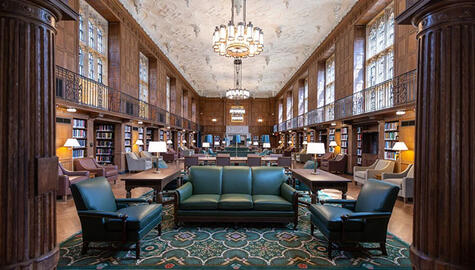
Sterling Memorial Library
(SML) was built with funds from the bequest of John W. Sterling, a New York
attorney who graduated from Yale in 1864. Mr. Sterling, who at his death in
1918 left most of his estate to Yale University, wished to have at least a portion
of the money used to create one magnificent and useful building which would
act as a memorial of his affection for his alma mater. By 1931, Sterling's total
gift to Yale amounted to over $29 million.
Designed
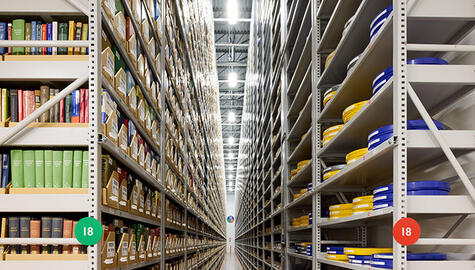
by James Gamble Rogers, the library was built to house 3.5 million volumes
in a bookstack tower intended to be the dominating feature of the facade,
something of an innovation for the time. The interior of the tower is a
self-supporting, unified structure of steel fused together by an electric
welding process which was new in 1928; this book tower was at the time the
largest such welding project ever undertaken. Although technically seven
stories high, the book tower actually contains sixteen levels of stacks.
In the days when the new library building was largely surrounded by much
smaller buildings, the sheer size of the tower stunned its viewers. The
impression of the size was heightened still more by the semi-Gothic style
of the tower, and its rather plain facade and elaborately crenellated battlements.
Attention to artistic detail pervades all of Sterling Memorial Library. As
a general rule, the ornamentation of each library area was designed to be
in harmony with the intended purpose of the room being decorated. A second
floor room originally designated as the English Study has window decorations
portraying King Lear, Hamlet, and Lady Macbeth; the offices of the Babylonian
Collection were given windows bearing the human-headed winged bulls of Ninevah
and the Babylonian lion. In larger areas, design schemes were even more
elaborate. The entrance hall relates, in stone and stained glass, the history
of the Yale Library. Carved stone panels below the windows represent such
events as the meeting of the Branford ministers in 1701 to form a "college
in the colonies", the Saybrook plea for the retention of the library, and
the British invasion of New Haven in 1779. The windows above the panels have
decorated panes that interweave the story of Yale and New Haven; the windows
show everything from a portrait of Elihu Yale to the ox carts that brought
the books from Saybrook.
Throughout SML, in almost every available wood, stone, and plaster surface,
is carved a design that will remind the viewer of the dignity and significance
of learning in general and of libraries in particular. A visitor passing
through the archway separating the nave from the exhibition corridor will
walk beneath four quotations on the value of written knowledge. Above the
circulation desk, field bosses on the ceiling represent various writing
implements, from quill pen to typewriter keyboard; and a painting of Alma
Mater on the backwall is surrounded by allegorical figures representing her
academic schools. In the exhibition corridor, stone corbels picture scenes
that include a fifteenth century scholar, a reader with a book and jug, and
a student receiving his diploma. Countless windows throughout the building
are glass representations of great literary works, such as Blake's Songs
of Innocence and Twain's Huckleberry Finn. In the original Rare Book Room
(now Manuscripts and Archives), each decorative pane is a tale from Aesop's
Fables. The original Medical Study on the fifth floor has one window showing
a witch shooting pain into a man's foot, a picture copied from an illustration
in a fifteenth century medical text. Even a custodial closet, just outside
the renovated Starr Main Reference Room, is decorated with a mop, pail, broom,
and brush.
The sculptor responsible for much of the stone carving within SML was Rene
P. Chambellan. He drew his inspiration not only from well-known literary
works but from their illustrations; from symbols of historic, philosophic,
religious, or mythological significance; from nature; and from the heraldry
of the University itself.
The library's windows, with their tracery and leaded glass, were designed
by G. Owen Bonawit. Like Chambellan, Bonawit received his ideas from the
scholarly world around him. The decorative panes in his windows were inspired
by book sources from around the world, many of which are now housed in Yale's
Beinecke Rare Book and Manuscript Library.
Even the most unexpected portions of SML have been adorned in the manner
of a Gothic cathedral, but in this case to the greater glory of scholarship
and the dignity of libraries. The iron doors of the public elevators were
wrought by Samuel Yellin and represent Medicine, Law, Shipping, Manufacturing,
Agriculture, Chemistry, Husbandry, and Machine Work. Yellin was also responsible
for the ornamental iron gates that stand between the Wall Street entrance
and the Exhibition Corridor. Many of the plaster ceilings are either painted
or bordered with decorative friezes, and such decorative schemes do not cease
in the areas of the building open to the public: the staff lounge has windows
decorated with such characters as Jack Spratt and his wife and Jack Horner,
and a staff restroom has windows made colorful by heraldic shields.
In brief, the ornamentation within Sterling Memorial Library is beautiful,
detailed, all-pervading, and symbolic of the history and universality of
the libraries of the world. This art work contributes much to the unification
of form and function in a building that affirms the value of knowledge and
scholarship at Yale, and the enduring nature of the written word.
Go to Sterling
Memorial Library Renovation Web site
Go to Yale University Library Front
Door
© 2007 Yale University Library
This file last modified 04/06/04
Send comments to diana.timlin@yale.edu