Preposterous Headdresses and Feathered
Ladies:
Hair, Wigs, Barbers, and Hairdressers
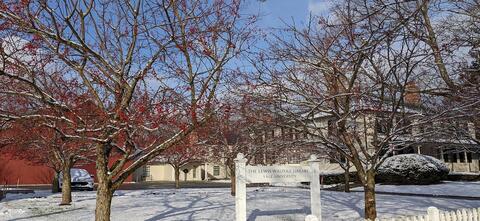
An Exhibit at the Lewis Walpole Library: May 8 -
October 29, 2003
In the second half of the eighteenth century
the hair of the fashionable world in England soared to new
heights. From the Lewis Walpole Library’s collection here
is a selection of prints focused on hair and wigs, and on
the hairdressers and barbers who created and tended them.
These images of “preposterous” hairstyles
give evidence of the increased economic prosperity that made
possible such extreme fashions as well as the luxury goods
necessary to them. At the time of publication, the prints
also served to communicate and disseminate the latest styles
to a broader public.
English women borrowed fashionable hairstyles
from France, particularly Marie Antoinette’s fanciful headdresses,
and English men returning from the Grand Tour brought back
fashions as well as objets d’art. From the beginning
there was ambivalence among the English about extravagant
fashion, and the extreme style adopted by the young gentlemen
back from their European travels, dubbed “Macaronies,” was
usually portrayed as ridiculous and sometimes even as unnatural.
In 1764 Horace Walpole mentioned “The Maccaroni Club (which
is composed of all the travelled young men who wear long
curls and spying-glasses),” and a writer in the Oxford
Magazine had this to say in 1770: “There is indeed a
kind of animal, neither male nor female, a thing of the neuter
gender, lately started up amongst us. It is called Macaroni.
It talks without meaning, it smiles without pleasantry, it
eats without appetite, it rides without exercise, it wenches
without passion.”
In addition to reflecting an English distrust
of Continental (specifically French and Italian) excess in
dress and manner, some of the prints also point up the confusion
and sense of disorder caused by attempts at upward mobility.
Satiric images abound of men and women putting on the clothes,
and trying for the manners and hairstyles, of the upper classes.
Note :
Our understanding of these prints is indebted to Frederick
George Stephens and Mary Dorothy George, Catalogue of
Personal and Political Satires Preserved in the Department
of Prints and Drawings in the British Museum (London:
British Museum Publications, 1978), abbreviated here to BMCat. References
are to numbered descriptions in this work.

The five orders of Perriwigs as they were worn at the
late Coronation, measured Architectonically.
[William Hogarth (1697-1764)]
London: Published by William Hogarth, [1761].
Engraving. 761.10.15.1.2
BMCat 3812
 |
Hogarth’s
representation of the headdresses he imagined might
have been worn at the coronation of George III and
Queen Charlotte reflects a preoccupation with fashionable
hairstyles documented by Walpole, who witnessed the
ceremony. Walpole wrote to Conway (25 September 1761); “Some
of the peeresses were dressed over night, slept in
armchairs, and were waked if they tumbled their heads.” Hogarth
is also poking fun at antiquarians who believed that
the beauty of a work of art could be explained by measurements
and proportions. Hogarth includes portraits; in the
fifth Order, to the far left, is a profile of Queen
Charlotte. |
Wigs
London: Published by M. Darly, October 12, 1773.
Etching and engraving.
773.10.12.1.2
BMCat 5170
 |
A man’s
profession often dictated the sort of wig he wore.
Lawyers favored full-bottom wigs (long wigs reaching
to the chest), merchants affected tie-wigs and queue-wigs
(the hair at the neck was tied with a ribbon), and
clerics wore bob-wigs (short frizzed wigs without
queues). According to George in the BMCat,
these heads are probably portraits, one meant to
caricature Lord Chancellor Bathurst. This print has
a companion, Hats, showing twelve styles of
fashionable hats worn by men. |
Debating Society (Substitute for Hair Powder)
[Isaac Cruikshank (1756?-1811?)]
London: Published by Laurie & Whittle, May 5, 1795.
Etching and engraving. 795.5.5.1
BMCat 8771
 |
In
1795, under William Pitt, a tax on hair powder was
imposed, probably contributing to the increased popularity
of natural hair at the end of the century. It has
been said that when the tax was enacted, Whig leaders
met and cut off their queues, thus heralding a move
toward less extravagant hairstyles. |
Wigs All the Rage, or a Debate on the Baldness of the
Times
Richard Newton (1777-1798)
London: Published by Laurie & Whittle, May 24, 1798.
Etching and engraving. 798.5.24.2
BMCat 9325
 |
In contrast with the styles of a quarter-century earlier,
the wigs held aloft by these men and women all
imitate natural hair. |
[The Barber Politician]
[c. 1771]
Engraving. 771.0.61
 |
The artist of this anonymous print shows the barber and his
client engaged in strenuous conversation over
the latest news. Walpole, in a letter to Horace
Mann (13 July 1773), stops his mock ranting with
the words, “Lord bless me, I run on like a political
barber.” |
The Village Barber. L.M. [Licentiate of Medicine]
Henry William Bunbury (1750-1811)
James Bretherton (fl. 1770-1781)
London: Published by J. Bretherton, March 1, 1772.
Hand-colored etching. 772.3.1.2
 |
This barber holds the tools of his trade: a lancet, a razor,
and a shaving dish. Over his house, shown in the
background, is the sign of a wig, and a board advertises
not only categories of wigs but also food and drink,
washing aids, and cures for various ailments: "BOBS,
BOB-Majors SCRATCHES [plain wigs] & other wigs
made here, also SAUSAGES, WASHBALLS[soap] Black
Puddings Scotch Pills, Powder for the ITCH, RED
HERRINGS, BREECHES BALLS & small BEER by the
maker." |
A Penny Barber
[Thomas Rowlandson (1756-1827)].
London, Published by William Holland, [1789].
Etching with aquatint. 789.0.59
BMCat 7605
 |
The barber holds his bowl and soap and is watched with apprehension
by his customer. Meanwhile, another man is stanching
a wound over a basin, and the barber's helper irons
a wig. On the floor and on the walls are wigs
(including the customer's?), wig-blocks, and a
razor. |
A Proctor without a Wig
George Moutard Woodward (ca. 1760-1809)
Engraving by Cruikshanks [i.e., Isaac Cruikshank (1756?-1811?)]
London: [Published] by Allen & West, January 14, 1797.
Engraving. 797.1.14.1
BMCat 9115
The Shaver and the Shavee
Henry William Bunbury (1750-1811)
Charles Bretherton (d. 1783)
London: Published by S.W. Fores, April 12, 1801.
Hand-colored etching. 801.4.12.1
BMCat 4756
A French Hair Dresser Running through the Streets
to his Customers
[P. Stevenart?]
London: Published by W. Darling, March 1, 1771.
Engraving. 771.3.1.2
BMCat 4767
 |
At the beginning of the century London had very few hairdressers;
in 1795 more than 50,000 were practicing their
art in Britain. It was widely acknowledged that
the best hairdressers were French, and they were
in great demand. The shears on his hip and the
combs in his hair proclaim this man’s trade. George,
in the BMCat, suggests that Bunbury drew
this image. |
A Hint to ye Husbands, or the Dresser, Properly Dressed
London, Printed for R. Sayer & J. Bennett, August
14, 1777.
Mezzotint. 777.8.14.1
 |
The husband here threatens the hairdresser with his riding
whip while the lady leans back in mild alarm. |
The Boarding-School Hair-Dresser
London: Printed for Robert Sayer, September 24, 1786.
Mezzotint. 786.9.24.1
 |
A hairdresser is constructing a girl's coiffure, surrounded
by implements strewn about the floor. On the table
are a guitar and music, which, together with his
intimate stance, suggest the need for a chaperone. |
New Head Dresses for 1772
Designed by D. Richie, Hair Dresser
September 1, 1772.
Etching and engraving. 772.9.1.1
 |
These six heads show the latest hairstyles for 1772; the print
must have served as an advertisement for Mr. Richie’s
skill. |
Miss Prattle, consulting Doctor Double Fee about her
Pantheon Head Dress
London: Printed for Carington Bowles, February 8, 1772.
Hand-colored mezzotint. 772.2.8.1
BMCat 5092
 |
Both the lady in her enormous pyramid of hair and the good
doctor in his legal wig and gown are slyly reflected
in the picture on the wall above them of two monkeys
taking tea. |
The Paintress of Maccaroni’s
London: Printed for Carington Bowles, April 13, 1772.
Hand-colored mezzotint. 772.4.13.1.1
BMCat 4582
 |
It has been suggested that the painter caricatured here is
Angelika Kauffman. The Macaroni sitter is yet
another of this era’s extravagantly dressed and
bewigged fashionable gentlemen. |
The Macaroni Painter, or Billy Dimple Sitting for his
Picture
Robert Dighton (1752-1814)
Engraving by Richard Earlom (1743-1822)
London: Printed for Bowles and Carver, September 25, 1772.
Mezzotint. 772.9.25.1.1
BMCat 4520
 |
The Macaroni Painter is Richard Cosway, R.A., known for his
foppish dress. The sitter, in full Macaroni regalia,
appears entirely satisfied with himself. |
The Macaroni. A real Character
at the late Masquerade
Philip Dawe
London: Printed for John Bowles, July 3, 1773.
Mezzotint. 773.7.3.1.2
BMCat 5221
 |
This gentleman shows off the fashion of the day, from the
rosettes on his shoes to the tiny three-cornered
hat at the top of his headdress, a structure made
of enormous side curls, a gigantic club, and a
pyramid of hair. While the Oxford English Dictionary cites
Walpole’s comment in 1764 as the first recorded
use of the term, the Macaronies came to greatest
prominence in the early 1770s. |
The Old Beau in an Extasy
J. Dixon
London: Printed for Carington Bowles, [July 13, 1773].
Hand-colored mezzotint. 773.7.13.2
BMCat 4532
 |
The Old Beau’s hair is drawn into the fashionable style of
a toupée to which the valet is fastening
a huge club of false hair. It is worth noticing
the curtain’s tassel, whose shape and decoration
suggest an ass’s head hovering over the Old Beau
as he admires himself in the mirror. |
The Preposterous Head Dress, or the Featherd Lady
London: Published by M. Darly, March 20, 1776.
Etching and engraving. 776.3.20.1
BMCat 5370
 |
Both the lady and her maid sport the inverted heart-shaped
pyramid all the rage in 1776 and 1777. The Duchess
of Devonshire was said to have begun the fashion
for ostrich feathers, seen here decorating the
headdress along with fruit and carrots. Late in
her life Lady Louisa Stuart wrote about the opposition
to ostrich feathers as part of a headdress: "This
fashion was not attacked as fantastic or unbecoming
or inconvenient or expensive, but as seriously
wrong or immoral. The unfortunate feathers were
insulted mobbed burned almost pelted." (quoted
in George, BMCat, V, 237). |
Lady All-Top
London: Published by J. Lockington, May 15, 1776.
Etching and engraving. 776.5.15.1
 |
Shown here is another magnificent heart-shaped pyramid of
hair adorned with ostrich feathers, beads, and
flowers, of the sort made fashionable by the Duchess
of Devonshire in 1776. These hairstyles were labor-intensive
and required cushions and wool, pomatum and powder,
and an array of decorations. They were uncomfortable,
they attracted insects and mice, and they could
be fire hazards. |
Oh. Heigh. Oh.
Or a View of the Back Settlements
London, Published by M. Darly, July 9, 1776.
Etching and engraving. 776.7.9.1.2
 |
In addition to poking fun at the highly decorated hairstyle
of the day, this print alludes to the Ohio territory
and thus to the coming American war. |
Rural Masquerade Dedicated to the Regatta’ites
London, Published by J. Lockington, July 9, 1776.
Etching and engraving. 776.7.9.2
BMCat 5379
 |
In the upper reaches of this headdress are figures dressed
for a masquerade, promenading through a garden. Below
is shown what may represent the first regatta in
England, held 23 June 1775, partly on the Thames
and partly at Ranelagh, where a temple of Neptune
had been built. The bearer of this enormous coiffure,
despite the female body, may be meant to be Neptune
or Father Thames. |
Phaetona or Modern Female Taste
London: Published by M. Darly, November 6, 1776.
Etching and engraving. 776.11.6.1
BMCat 5375
 |
The lady and her hair dwarf the horses pulling her carriage,
a phaeton. The Duchess of Devonshire may be the
intended object of the satire here, given the ostrich
feathers in the hair and the ducal coronet on the
carriage. |
Miss Shuttle-Cock
R.S. [Monogram; i.e., "Richard Sneer," perhaps
Richard Brinsley Sheridan]
London, Published by M. Darly, December 6, 1776.
Etching and engraving. 776.12.6.1
BMCat 5376
 |
Here a man in clerical garb and his opponent,
probably "Richard Sneer," use a lady
as their shuttlecock. Lifted high in the air by
the ostrich feathers in her hair, the lady's flight
is helped by the light-weight cork used to shape
the back of her dress.
George, in the BMCat, remarks that this
print may have suggested these lines from David
Garrick's prologue to Sheridan's Trip to Scarborough (first
performed 24 February 1777):
Ladies may smile--are they not in the plot? The bounds of nature have not they forgot? Were they design'd to be, when put together,
Made up, like shuttlecocks, of cork and feather?
|
The New Rigatta
R.S. [Monogram, i.e., "Richard Sneer," perhaps
Richard Brinsley Sheridan]
London: Published by M. Darly, February 20, 1777.
Etching and engraving. 777.2.20.1
 |
These racing ladies are floating on their “cork rumps” and
being propelled by the breath expelled from three
heads and directed toward their well-feathered
headdresses. Heading for the arches of a bridge,
the three are competing for prizes, among them “an
entire new Wig” and “a new pair of Corks.” |
Tight Lacing
R.S. [Monogram; i.e., "Richard Sneer," perhaps
Richard Brinsley Sheridan] J.H.
London: Published by William Holland, [March 1777?].
Hand-colored etching and engraving. 777.3.0.9
BMCat 5452
 |
The lady's maid has wound her mistress's stay-laces around
a poker and is pulling with all her might, one
foot braced against her skirt, which has been extended
by a "cork rump." |
Tight Lacing. Or Hold Fast Behind
M.D. [Monogram; Matthew or Mary Darly]
London: Published by M. Darly, March 1, 1777.
Etching and engraving. 777.3.1.4
Tight Lacing, or the Cobler’s Wife in the Fashion
London: Published by William Hitchcock, November 4,
1777.
Hand-colored etching and engraving. 777.11.4.1
BMCat 5464
 |
Behind the cobbler and his wife is a picture of a leg of mutton
and turnips, whose shape is reminiscent of the
wife's headdress. |
Miss Juniper Fox
London. Published by M. Darly, March 2, 1777.
Hand-colored etching and engraving. 777.3.2.1
Slight of Hand by a Monkey--or the Lady’s Head Unloaded
London: Printed for Carington Bowles, c. 1770.
Mezzotint.
BM 4546
 |
Both the butcher's boy with his basket and a young man on
the other side of the wall are amused by the monkey's
stealing of the fine lady's extravagant headdress. |
The French Lady in London, or the Head Dress for the
Year 1771
From an original drawing by Samuel Hieronymus Grimm
(1733-1794)
London: Printed for S. Sledge, April 2, 1771.
Etching and engraving. 771.4.2.1
BMCat 4784
 |
The size of the lady’s headdress is echoed by the mountain
landscape on the wall behind her. Her curtsey
has sent the gentleman’s book (G.A. Stevens’s Lecture
upon Heads) tumbling to the floor and has terrified
the dog, cat, and parrot. |
L’Inconvenient des Perruques. The Inconvenience of
Wigs
C. Vernet [Carle Vernet (1758-1836)?]
Engraving by F. Sansom (fl. 1788-1800)
London: Published by S.W. Fores, April 7, 1798.
Etching and engraving. 798.4.7.2
Progress of the Toilet. The Wig
James Gillray (1756-1815)
London: Published by H. Humphrey, February 26, 1810.
Hand-colored etching and engraving. 810.2.26.2
BMCat 11609
 |
This is the second in a series of three plates describing
a lady's toilet. The first is "The Stays" and
the third, "Dress Completed." Here the
lady alternately reads Madame de Stael's Delphine and
gazes into the mirror while her lapdog sleeps on
a stool and her maid readies her wig. |
A Doleful Disaster, or Miss Fubby Fatarmin’s Wig Caught
Fire
Thomas Rowlandson (1756-1827)
London: [Published] by Thomas Tegg, [1813].
Colored etching. 813.9.20.1
BMCat 12147
 |
Accidents such as this print depicts must not have been uncommon. |
|
|
| |
|
| |
|
| |
|
| |
|
| |
|
| |
|
|