images with links Image with links

Information > The Library and Its History

The Library Today

Photo of Library Interior
Photograph by Richard Caspole
Yale Center for British Art, 1999

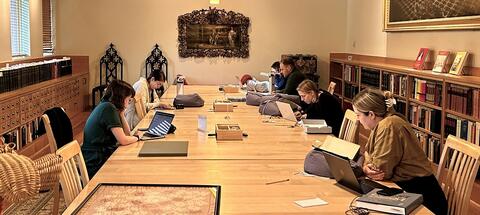
The Lewis Walpole Library, a department of the Yale University Library since 1980, is an internationally recognized research collection in the field of British eighteenth-century studies. Its unrivalled collection of Walpoliana includes half the traceable volumes from Horace Walpole’s famous library at Strawberry Hill and many letters and other manuscripts by him. The Library’s book and manuscript collections, numbering over 32,000 volumes, cover all aspects of eighteenth-century British culture.

The Library is also home to the largest and finest collection of eighteenth-century British graphic art outside the British Museum; its 35,000 satirical prints, portraits, and topographical views are an incomparable resource for visual material on many facets of English life of the period.

Located in Farmington, Connecticut, forty miles north of New Haven and within easy distance of Boston and New York, the Lewis Walpole Library’s collections also include drawings, paintings, and furniture, all housed on a 14-acre campus with four historically important structures and extensive grounds. The Library runs an active fellowship program and sponsors conferences, lectures, and exhibitions in cooperation with other Yale libraries and departments.

For information about the Library's renovation project, click here.

Brief History of the Library -- Lewis, Walpole, and the Library

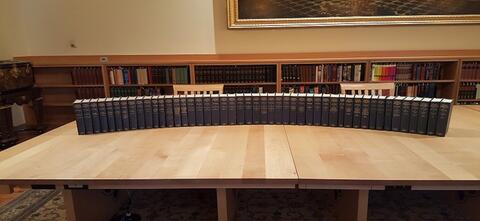
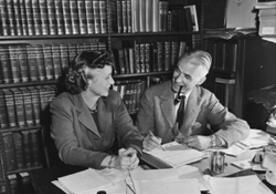
Lewises in their libraryWilmarth Sheldon Lewis, “Lefty” to his friends, began collecting books not long after his 1918 graduation from Yale. On a trip to London in 1923, Lewis bought a copy of John Heneage Jesse’s George Selwyn and His Contemporaries that was full of manuscript notes by Lady Louisa Stuart. Her lively commentary about the people and events described in the book piqued Lewis’s interest and led him eventually to Horace Walpole. Walpole (1717-1797) was the youngest son of Sir Robert Walpole, England’s first prime minister, and an energetic letter-writer for most of his long life. The view of the eighteenth century afforded by Walpole’s correspondence fascinated Lewis and led to his lifelong pursuit of all things Walpolian. Lewis acquired books, manuscripts, and prints as well as graphic and decorative arts, all in an extraordinary effort to gather information about Horace Walpole and his times, his house at Strawberry Hill in Twickenham, his interests, and his friends and contemporaries. Lewis spent nearly half a century, until his death in 1979, editing Walpole’s correspondence. Fully indexed and annotated, The Yale Edition of Horace Walpole’s Correspondence extends to 48 volumes and remains a remarkable accomplishment.

Lewis and his wife, Annie Burr Lewis, left their collection, house, and grounds to Yale to be known as the Lewis Walpole Library or, as he referred to it unofficially, Yale in Farmington.Theodosia portrait

 
Included in the household collection is John Vanderlyn's so-called "Nag's Head" portrait of Theodosia Burr Alston, daughter of Vice-President Aaron Burr.


Library Buildings

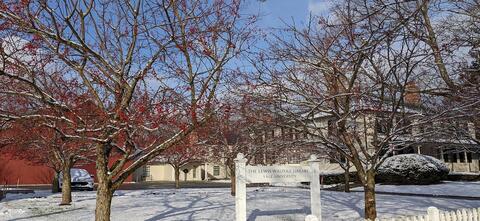
Photograph of Cowles House by Richard Caspole, Yale Center for British Art, 1999.
Photograph by Richard Caspole
Yale Center for British Art, 1999

The Library sits on 14 acres of mostly cleared land about a mile south of Farmington Center. The land is bordered on the west by the Pequabuck River just south of its junction with the Farmington River and by the remains of the Farmington Canal that ran from New Haven to Northampton in Massachusetts 150 years ago. Nearby are some excellent walking, jogging, and bike routes (the Library even provides a bike). Some specimen trees of interest among the many maples on the property are a Dawn Redwood (Metasequoia) and a healthy American Elm. Most open land is left as field or cultivated as lawns, although there are some courtyard gardens immediately west of the Library Building.

The Library building is one of four on the site, and the most prominent from Main Street. It is a two-story white Georgian-style house built about 1784 for Revolutionary War General Solomon Cowles. It is thought that the front porch wrapping two sides of the house may be one of the earliest examples of a porch original to the design and not a later addition. It is also believed that the intricately carved wood paneling and trim on the first floor interior is the work of Hessian prisoners of war. The Lewises engaged the architect William Adams Delano to design their late 1920s addition to the house to accommodate their growing collection.

Next door to the Library is a simpler two-story white frame Colonial-style house, built for Army Captain Timothy Root in the same year as the Cowles House. It was completely renovated in 2001 to accommodate scholars working with the Library's collections, and now boasts nine bedrooms, each with private bath.

In the center of the Library "campus quadrangle" is The William Day Museum of Indian Artifacts, a small, one-story red structure originally built 250 years ago by local Native Americans as part of their residence. It was moved to its present location to house an exhibit of artifacts first unearthed on the site by Bill Day, the Lewises' caretaker; later, Yale archaeologists organized several digs.

Finally, a large red barn of eight bays with full loft completes the building complex. Originally used for agriculture and livestock, it now houses the facilities workshop and grounds equipment.

Selected further reading:

Cornforth, John. "The Cowles-Lewis House, Farmington : the Home of Mr. Wilmarth S. Lewis." Country Life, 163, no. 4216 (April 27, 1978): 1150-53, and 164, no. 4217 (May 4, 1978): 1230-33.

Lewis, W. S. Collector's Progress. New York: Knopf, 1951.

Lewis, W. S. One Man's Education. New York: Knopf, 1967.

"The Lewis Walpole Library: a Piece of Yale in Farmington."
Yale Bulletin and Calendar News Stories, 24, no. 3 (1996).
http://www.yale.edu/opa/ybc/v24.n33.news.15.html .

"Life Explores World's Finest Walpole Library." Life Magazine, 23 October 1944, 116-117.

Notes by Lady Louisa Stuart on George Selwyn and His Contemporaries by John Heneage Jesse. Edited from the original manuscript by W.S. Lewis. New York: Oxford University Press; London: H. Milford, 1928.

Peltz, Lucy. "A Scholar's View of the Walpole Library." Nota Bene 10 (Fall 1996).
http://www.library.yale.edu/NotaBene/nbx3/nbx3.htm

Shenker, Israel. "Can He Be the Real Horace Walpole--or Is He Wilmarth Lewis, a Yale Scholar Who 'Lives' in the 18th Century?" Photographs by Marvin E. Newman. Smithsonian 10 (May 1979): 102-108.

Stillwell, John E. The History of the Burr Portraits, Their Origin, Their Dispersal and Their Reassemblage, [New York?] 1928.

Walpole, Horace. The Yale Edition of Horace Walpole's Correspondence. Edited by W.S. Lewis [et al.]. New Haven: Yale University Press, 1933-1983.

 
navigation bar
 

The Lewis Walpole Library
Contact Information

Search this site

Yale University Library
Yale University


© 2004 Yale University Library
This file last modified:
08/22/07
Send comments to Susan Odell Walker